Silica Aerogel: Frozen Smoke in Structural Glazing
For over a century, architects have operated under an uncompromising physical paradox: transparent windows that admit daylight are chronic thermal vulnerabilities, while opaque insulated walls that preserve heating and cooling energy cast deep shadows. Silica aerogel—a synthetic, ultralight nanoporous solid first synthesized by Samuel Stephens Kistler in 1931—collapses this dialectic by pairing structural translucency with insulation values superior to static air.
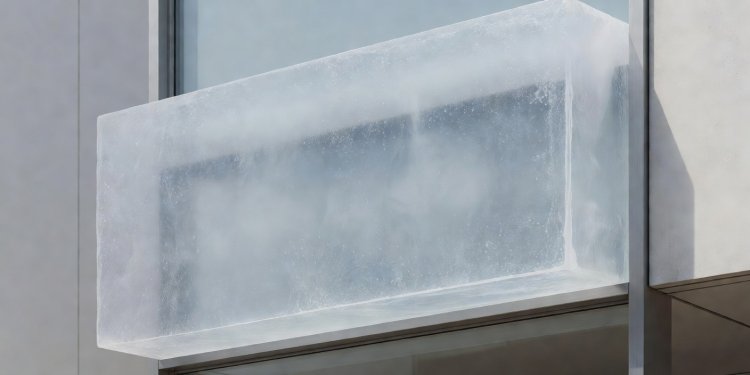
Nanoporous Morphology and the Knudsen Effect
Silica aerogel consists of 95% to 99.8% air by volume, supported by an intricate three-dimensional skeleton of silicon dioxide (SiO₂) nanospheres. The average pore size within this dendritic network is between 20 and 40 nanometers. This measurement is critical because it is smaller than the mean free path of gas molecules (air molecules travel approximately 68 nanometers before colliding with another molecule at ambient pressure).
Trapped inside pores smaller than their own collision trajectory, nitrogen and oxygen molecules cannot transfer kinetic heat energy via convection or molecular collision. This thermodynamic phenomenon, known as the Knudsen Effect, drops the thermal conductivity of silica aerogel down to an astonishing 0.012 to 0.018 W/mK—far superior to polyurethane foams, rockwool, or traditional mineral blankets.
Architectural Daylighting Integration
In contemporary building practice, monolithic aerogel tiles or granular aerogel pellets are sealed hermetically between twin glass leaves or structural polycarbonate channels. The resulting glazing system provides:
Core Glazing Metrics
• Thermal U-Value: As low as 0.28 W/m²K in a 50 mm thick unit, equaling the performance of solid masonry.
• Diffusion Quality: 100% glare-free light scattering. Eliminates hot spots and shadow contrasts without interior blinds.
• Acoustic Isolation: Nanoporous tortuosity drastically disrupts acoustic sound waves, cutting airborne street noise by up to 48 dB.
Heritage Retrofitting and Thin-Envelope Horizons
Beyond modern commercial envelopes, aerogel insulation plasters and slender vacuum insulation panels (VIPs) are revolutionizing architectural conservation. Historic listed stone facades cannot tolerate thick exterior rockwool cladding without destroying ornamental bas-reliefs and cornice lines. A mere 20 mm layer of aerogel-infused lime render increases historic wall insulation by 300% without altering exterior facade profiles.