Translucent Stone: The Weightless Earth Membrane
For millennia, stone embodied the quintessential architectural condition of heavy permanence: thick ashlar blocks, load-bearing granite plinths, and light-impermeable basalt foundations. Yet throughout architectural history, rare exceptions defied this opacity. When Gordon Bunshaft completed the Beinecke Rare Book & Manuscript Library at Yale University in 1963, he utilized 1.25-inch panels of Vermont marble, framed in granite trabeations. Under harsh daylight, the stone transformed into a warm, glowing amber perimeter, sheltering centuries-old codices from damaging ultraviolet rays while illuminating the interior sanctuary without artificial illumination.
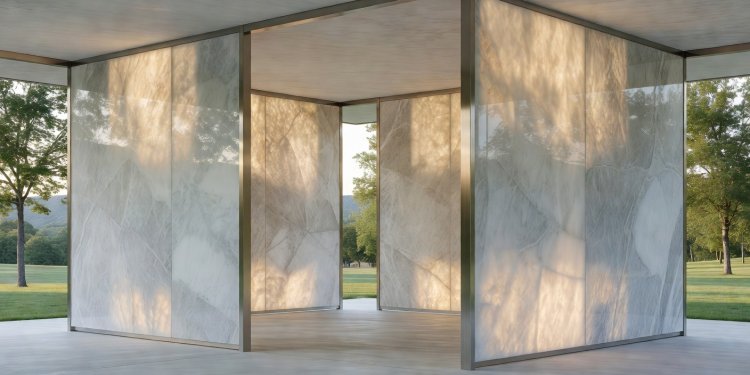
Crystalline Geochemistry: Why Certain Stones Transmit Luminescence
Translucency in mineral matter requires specific crystalline organization. In metamorphic marble and sedimentary onyx (a banded variety of chalcedony or calcium carbonate), calcite crystals exhibit interlocking mosaic geometries devoid of opaque iron oxides or carbonaceous residues. When sliced to microscopic or millimetric thicknesses (typically between 3 mm and 8 mm), photonic energy is not reflected backward by coarse aggregate boundaries; instead, it undergoes internal refractive scattering.
The resulting illumination is devoid of glare. The mineral lattice acts as an organic optical filter, scattering direct solar radiation into an isotropic, warm-spectrum wash. In modern engineering, this structural thinness is achieved through diamond-wire multi-axis gang saws capable of slicing delicate stone slabs with tolerances within fractions of a millimeter.
Composite Glass Laminates: Engineering Structural Integrity
A natural stone slice of 4 mm thickness possesses negligible flexural strength and is prone to micro-fissuring under wind loads or thermal expansion. The contemporary breakthrough lies in structural glass sandwich lamination. Using high-clarity ethylene-vinyl acetate (EVA) or polyvinyl butyral (PVB) interlayer films autoclaved under high vacuum, the fragile stone slice is permanently bonded between two panes of low-iron toughened glass.
Technical Parameters of Laminated Onyx Units
• Visual Light Transmittance (VLT): 8% to 34%, varying by natural vein density and resin tint.
• Solar Heat Gain Coefficient (SHGC): 0.18–0.26, dramatically outperforming standard double-pane solar glazing.
• Flexural Resistance: Exceeds 90 MPa equivalent when bonded to 8 mm tempered outer float panels.
• Acoustic Damping: 42 dB Rw reduction across mid-frequency urban disturbance bands.
Pioneering Realized Applications
Beyond historical precedents like the San Miniato al Monte in Florence or the Orvieto Cathedral's alabaster clerestories, contemporary architects utilize engineered stone skins in extreme climates. At the Rafael Moneo-designed Kursaal Congress Centre in San Sebastián, Spain, curved double-skin glass walls incorporate interior translucent stone components to diffuse harsh coastal Atlantic sunlight. In the Persian Gulf, high-density residential towers employ onyx louvers to deflect extreme midday irradiance, reducing mechanical cooling loads by up to 28% compared to standard vision glass facades.
The philosophical implication of translucent stone is profound: it subverts our expectation of mass. The earth no longer anchors the envelope in shadow; instead, the mountain becomes the window.