Mycelium Bio-Composites: Growing the Structural Frame
The manufacturing of standard building materials accounts for approximately 11% of total global greenhouse gas emissions, driven primarily by the thermal calcination of limestone for Portland cement and the energy-intensive smelting of structural steel. In response, structural biologists and vanguard architectural practices are turning toward living organism architecture: specifically, the vegetative root structure of fungi, known as mycelium.
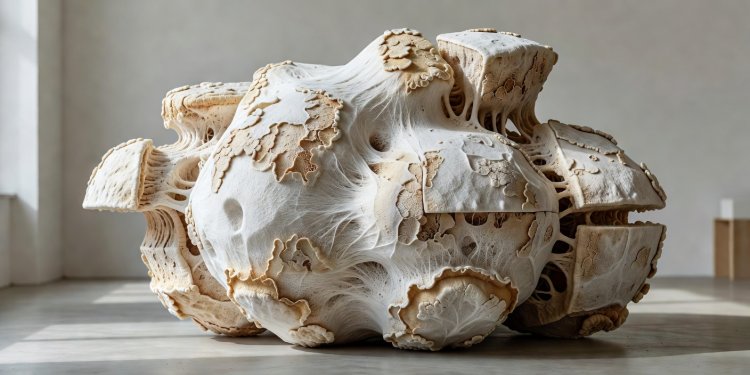
The Cultivation Cycle: From Agricultural Residue to Solid Masonry
Mycelium composite production is an additive, self-assembling biological protocol. Agricultural waste streams—such as hemp hurds, chopped corn stalks, flax fiber, or sawdust—are pasteurized to neutralize native microbes and inoculated with pure fungal strains, commonly Ganoderma lucidum or Pleurotus ostreatus. The mixture is placed into rigid precision negative molds.
Over a four to seven-day cycle inside dark, climate-controlled fermentation cleanrooms, the microscopic hyphae extend exponentially, secreting biological enzymes that break down cellulose into digestible sugars while weaving a dense, polymer-like matrix around the agricultural fibers. Once the geometry is fully consolidated, the block is extracted and heat-cured at 80°C to 110°C. This baking halts biological activity, permanently neutralizing mushroom fruiting potential while baking the chitinous cell walls into a rigid, hydrophobic, non-toxic building module.
Material Properties and Structural Limits
Cured mycelium presents an unusual physical profile. It is lighter than cellular aerated concrete, yet demonstrates high impact damping, natural fire retardancy, and acoustic absorption coefficients exceeding 0.75 NRC.
Performance Profile: Mycelium Bio-Blocks
• Compressive Strength: 0.35 MPa to 1.85 MPa (Non-load bearing partitions and compression vaults).
• Thermal Conductivity (λ): 0.038–0.045 W/mK (directly competing with expanded polystyrene insulation).
• Carbon Balance: Net sequestering; fixes 1.4 kg of atmospheric CO₂ per 1 kg dry mass during the growth phase.
• Reaction to Fire: Naturally self-extinguishing due to high surface chitin concentration; char layer prevents deep thermal breach.
Notable Architectural Demonstrations
The viability of structural mycelium was first dramatically proven at scale in 2014 by The Living (David Benjamin) with the Hy-Fi installation at MoMA PS1 in New York. A circular 12-meter-tall catenary tower was erected using 10,000 grown mycelium bricks manufactured without kiln baking. Over three months exposed to New York's summer humidity and wind storms, the tower maintained total structural cohesion. Upon decommissioning, the entire structure was composted on community gardens, leaving zero landfill debris.
Current research at institutions like ETH Zurich and Newcastle University's Hub for Biotechnology in the Built Environment is developing continuous bio-extrusion 3D printing, where paste-like living mycelium hydrogels are robotically printed into self-supporting rib vaulted ceilings.