Kinetic Shape-Memory Alloys: Motorless Facade Autonomy
Kinetic facades have long fascinated architects seeking responsive building envelopes. Yet the majority of mechanical kinetic envelopes—from motorized louvers to iris apertures—suffer from severe maintenance overhead: motorized servos seize, electrical control lines degrade in coastal salt air, and sensor microcontrollers require perpetual power and software maintenance. Shape-Memory Alloys (SMAs) eliminate the failure-prone electromechanical chain by embedding actuation directly within the crystalline structure of the metal.
The Solid-State Martensitic Phase Transformation
The foundational intermetallic compound for architectural SMAs is Nitinol (a near-equiatomic alloy of nickel and titanium, Ni-Ti). At lower temperatures, Nitinol rests in a compliant, low-symmetry monoclinic crystal lattice known as the martensite phase. In this state, the alloy can be deformed under mechanical tension without permanent plastic yield.
When sunlight strikes the facade and heats the metal past a tailored transformation threshold (typically calibrated between 24°C and 38°C for architectural climates), the atoms snap into a rigid, highly ordered cubic structure called the austenite phase. This instantaneous atomic rearrangement exerts enormous mechanical recovery stresses—up to 600 MPa—effortlessly lifting heavy glass shingles, flexing shading leaves, or opening ventilation channels without a single motor or electrical watt.
Thermo-Bimetallic Sheet Laminates
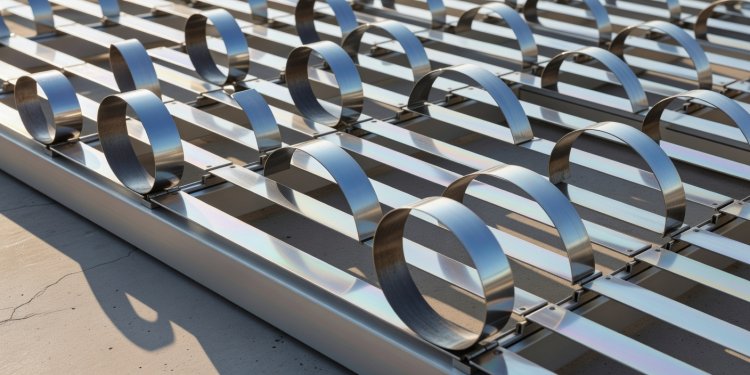
Parallel to intermetallic Nitinol, architects utilize thermo-bimetals: laminated sheets combining two metals with radically disparate thermal expansion coefficients (such as austenitic stainless steel cold-welded to a low-expansion nickel-iron alloy like Invar). As the diurnal solar arc heats the building envelope, one side expands significantly faster than the other, forcing the sheet into predictable mathematical curvatures.
Operational Advantages Over Servomotor Systems
• Zero Parasitic Power: Entirely driven by environmental thermodynamic gradients and solar radiant flux.
• Hyper-Fatigue Resistance: Nitinol can execute millions of transformation cycles without mechanical degradation.
• Fail-Safe Biomimetic Behavior: When cloud cover obscures the sun, cooling initiates natural relaxation without algorithmic logic.
Case Studies: Bloom and Adaptive Building Skins
Architect Doris Sung's seminal installation Bloom demonstrated how 14,000 unique thermo-bimetal components can form an autonomous, self-shading canopy that curls open to exhaust hot air when surface temperatures rise, and closes into an impermeable weather barrier during cool night hours. In commercial tower architecture, researchers at the Fraunhofer Institute for Machine Tools and Folding Technology have developed passive SMA-actuated facade ventilation flaps that prevent catastrophic overheating in high-density glazed skyscrapers.